
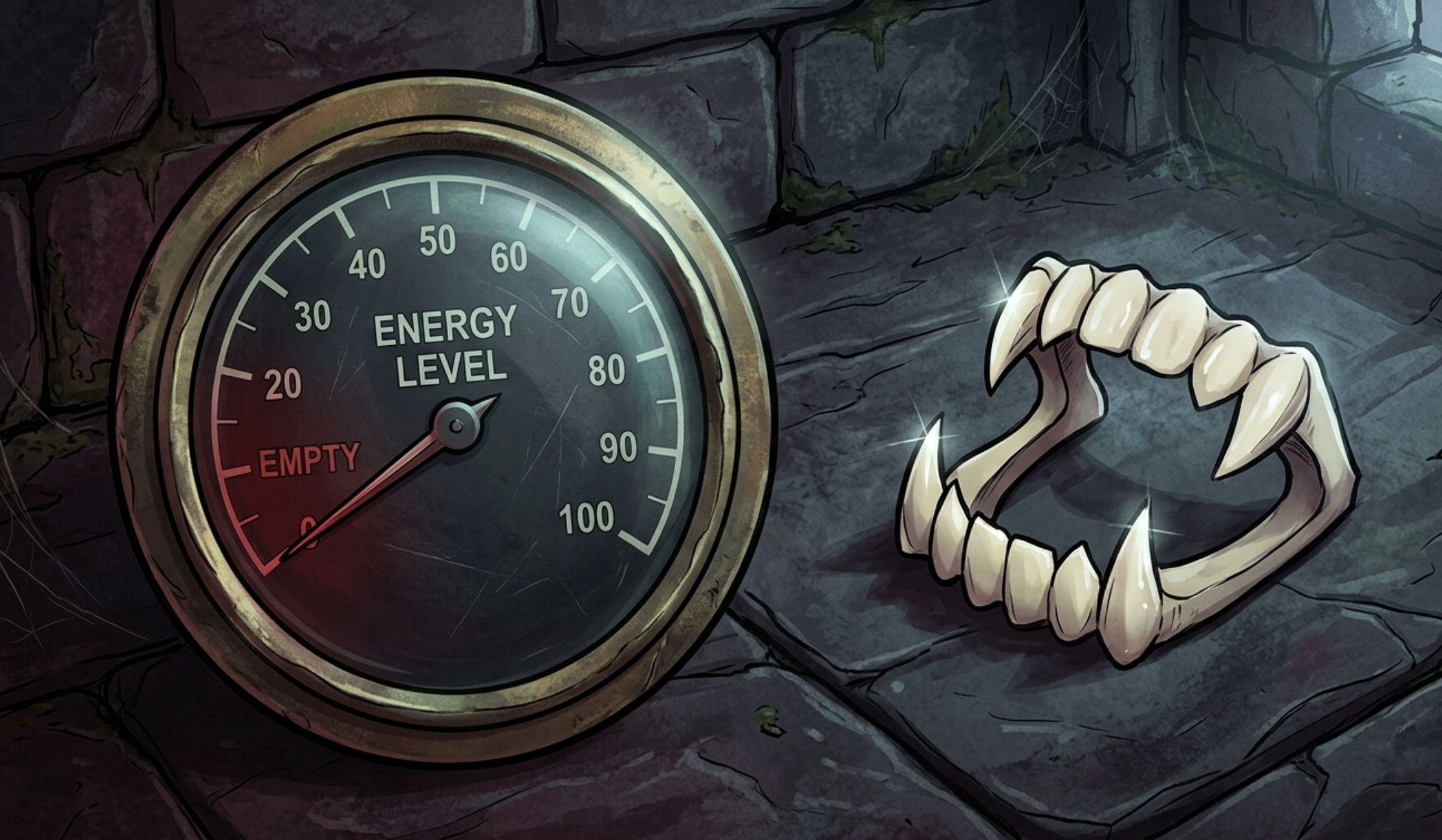
If you’ve ever watched What We Do in the Shadows, you’re probably familiar with Colin Robinson. Unlike his fellow vampires who go for the jugular, Colin is an energy vampire. He feeds by boring or frustrating people—monologuing about tax codes or the history of the pencil—until his victims are literally slumped over, drained of their will to live.
Eating disorders operate with a very similar, albeit much more sinister, comedy of errors. The disorder is the ultimate Colin Robinson. It follows you into the kitchen, the grocery store, and even your dreams, monologuing incessantly about calorie counts, the "correct" ratio of macronutrients, or whether that piece of fruit was worth it.
Repeatedly ruminating over these numbers is exhausting. It siphons off your zest for life, leaving you too depleted to care about your actual interests, your friends, or your own personality. Recovery is the process of finally telling that internal energy vampire to shut up so you can plug back into your own life.
Why Eating Disorders are Energy Vampires
When you are deep in the throes of an eating disorder, your world shrinks. The disorder doesn't just take your time; it siphons off your connection to others and replaces your unique likes and dislikes with a rigid set of external rules.
This isn't just a metaphor; it's biology. When the body is consistently under-fueled, it undergoes metabolic adaptation. Your metabolism slows down to conserve every possible resource because the body perceives it is in a state of starvation. This biological shift has profound consequences:
- Cognitive Fog: Starvation affects the brain long before it changes your body composition. Like the participants in the Minnesota Starvation Experiment, under-fueled individuals often develop obsessive thoughts about food, social withdrawal, and trouble concentrating.
- Emotional Instability: Without steady energy, mood becomes increasingly labile. What might look like "resistance" to treatment is often just a brain crying out for glucose.
- The Social Drain: The energy vampire thrives in isolation. Because engaging with friends requires energy and flexibility that the disorder has drained away, many people find themselves making excuses to stay home.
Using Science to Evict the Vampire
At The Kahm Center, we use tools like metabolic testing and body composition analysis as a way to measure exactly how much energy the vampire has stolen, and how much we need to put back.
We understand that in the eating disorder community, the idea of data can feel counterintuitive. However, these assessments are actually powerful tools for weight-neutral care. Instead of looking at the number on a scale—which tells us very little about your actual health—these tests look at biomarkers of internal function.
- Resting Metabolic Rate (RMR): This tells us if your body is receiving enough energy to support basic physiological processes like your heart beating.
- Cellular Health: These tools can provide objective evidence of malnutrition, even if your BMI is in the "normal" range.
- Resource Integrity: We assess lean muscle mass and bone density to see if the body has the resources it needs to maintain its structure.
By shifting the focus from how the body looks to how it functions, we can challenge the harmful weight stigma that often leads to misdiagnosis. This data also helps us advocate for you with insurance companies, providing concrete scientific evidence of medical need.
The Hard Work of Re-Fueling
One of the most difficult truths about recovery is that it is hard work. You are essentially asking a body that has been in power-save mode to turn all the lights back on.
As you begin to eat more consistently, you might actually feel more tired at first as your body begins the massive project of internal repair. Recovery requires:
- Abandoning the Rules: You cannot recover by just tweaking diet rules; you have to let them go entirely.
- Tolerating Uncertainty: As your body recalibrates, your internal signals for hunger and fullness may be unreliable. This is where the structure of a PHP or IOP program provides the "scaffolding" you need.
- Managing the "Food Police": Whether it’s an internal voice moralizing your choices or external cultural pressure, you have to learn to name these thoughts as fear-based rather than fact-based.
Reclaiming Your Zest
What does it look like when the energy vampire starts to lose its grip? It’s usually found in the return of the small things.
It’s the moment you realize you have the patience to sit and read a book with your child without falling asleep. It’s the return of a hobby you haven’t touched in years because you finally have the brain space to care about something other than calories. It’s the ability to meet a friend for coffee and actually listen to what they are saying instead of calculating the milk in your drink. The rumination begins to ebb and flow instead of pounding you incessantly like waves in a storm.
The days are becoming brighter. You did it.
Conclusion
The path to finding consistent energy levels isn't found in a new "wellness" protocol or a stricter gym routine. It is found in the radical act of nourishing yourself at a rate that outpaces the vampire’s efforts to drain you.
At The Kahm Center, we combine the clinical precision of metabolic testing with the compassionate, individualized support of therapy, groups, and medication management. We are here to help you turn the volume down on the monologue of the disorder so you can finally hear your own voice again.
Clinically Reviewed By
Nick Kahm, PhD
Co-Founder
Nick Kahm, a former philosophy faculty member at St. Michael's College in Colchester, VT, transitioned from academia to running the Kahm Clinic with his mother. He started the clinic to train dietitians in using Metabolic Testing and Body Composition Analysis for helping people with eating disorders. Now, he is enthusiastic about expanding eating disorder treatment through the Kahm Center for Eating Disorders in Vermont.
